Introduction
Brandon Johnson
Senior/staff software engineer — building payments infrastructure for the modern web. 15+ years designing and scaling distributed systems, APIs, and fintech platforms.
Entrepreneur, open source contributor, and University of Utah alum.

About
About Me
Senior/staff-level engineer with 14+ years designing and scaling distributed systems, APIs, and payments infrastructure. Most recently focused on building deterministic and idempotent systems for payment rails including ACH, RTP, FedNow, and bank account services. I've led engineering teams and co-founded multiple companies across fintech, real-time data pipelines, e-commerce, and SaaS.
| Name | Brandon Johnson |
|---|---|
| Location | West Jordan, Utah |
| Most Recent Role | Sr. Software Engineer |
| Education | B.S. Accounting (Information Systems emphasis), University of Utah |
| Specialties | Payments, Distributed Systems, Backend Engineering, Product Engineering |
| Languages | English, Portuguese |

Posts and Tips
Latest Posts
May 28, 2026
Eleven engineering roles over seventeen years, ranked by how much they actually shaped how I think.
I have had jobs that looked important on paper and barely changed me, and jobs that looked ordinary from the outside and quietly rewired how I think. This is not a ranking of companies, coworkers, compensation, or titles. It is a ranking of what each stop taught me. That makes it subjective, a little unfair, and probably the only useful way to do it.
EGreen PolkaDot BoxMagento Developer2009–2010Back to tier list First jobs matter because they turn possibility into evidence.
E · First ProofThe Moment It Became Real

Green PolkaDot Box was my first actual software job. I had already been writing code as a systems administrator, mostly because I kept finding processes that deserved to be automated, but this was different. This was a job where the work itself was programming. Magento, PHP, catalog modules, sales modules, enterprise migrations: all of it felt like being handed a map in a language I could almost read.
It lands in E tier not because it was unimportant, but because the lesson was narrow and foundational. It taught me that I could do the work. That is a huge thing to learn once. After that, the craft had to get bigger than proof of entry.
The lesson was simple: I was allowed to call this my work now.
What this job taught meConfidence is a real career asset, but it is only the starting line. This job turned programming from something I could do into something I could be hired to do.
SApptysCo-Founder · Lead Software and DevOps Engineer2009–2015Back to tier list Owning the whole problem teaches faster than owning a clean slice.
S · Whole SystemOwning the Whole Problem

Apptys was messy in the most educational way: client work, sales, finance, hiring, architecture, deployments, outages, estimates, and the emotional weather of running a small agency. I learned software as a business system there, not just as a technical artifact.
What this job taught meOwning the full loop taught me that software quality includes expectation-setting, delivery pressure, business tradeoffs, and trust. The code was only one part of the system.
CClearlinkSr. Full-Stack Developer2010–2013Back to tier list A great team can teach you culture while an immature stack teaches you engineering discipline.
C · Culture and CraftA Great Team on a Young Stack

Clearlink was an amazing cultural experience. The team was sharp and generous, the managers were excellent, and engineers were treated like the work mattered because it did. I loved the work I did there. The sales order system supported hundreds of sales associates, processed thousands of orders, talked to phone systems, brand partner APIs, and payment flows. The stakes were real, and the people around the work made it a genuinely energizing place to grow.
The C tier is not a people grade. It is about the maturity of the technical environment I was learning inside. The stack still had a lot of growing up to do: legacy PHP that had to be handled carefully, SVN-era workflows, and production paths that made staging feel optional. That contrast was useful. It gave me a vocabulary for why source control, environments, testability, and release discipline are not process theater. They are how great teams protect important systems from depending on everyone having a perfect day.
Clearlink taught me two things at once: how good a workplace can feel, and why technical maturity matters.
What this job taught meCulture can make hard technical environments feel energizing, but good culture deserves good engineering guardrails. I started to understand release discipline as a way of protecting both systems and people.
BGuidance SolutionsTechnical Lead · Magento2013–2014Back to tier list Technical leadership starts where implementation details meet responsibility.
B · Technical LeadershipArchitecture Had to Be Explainable

Guidance Solutions was a bridge from senior developer to technical lead. Large Magento projects, client-facing decisions, project managers, scrum meetings, and technical strategy all forced the same lesson: architecture is not just what you build, it is what you can explain and defend.
What this job taught meTechnical leadership is not just being right in private. It is making the strategy clear enough that clients, project managers, and engineers can all move with confidence.
ACricutSr. Software Engineer2015–2018Back to tier list Product engineering made the work feel less like code and more like leverage.
A · Product ScaleSoftware With a Physical Edge

Cricut was the first job where the software felt connected to something people could hold in their hands. APIs supported Design Space, mobile apps, embedded devices, e-commerce, and enough surrounding systems that the stack looked less like a tidy diagram and more like a working city.
That changed how I thought about quality. A backend endpoint was not just a contract between services; it was part of a chain that ended with someone making a card, a classroom project, a small business product, or a gift. The work had a consumer product gravity to it. You could not hide behind internal correctness. The experience had to survive contact with real people.
The code was successful only if it helped the machine, the app, and the person agree.
What this job taught meProduct engineering made quality feel tangible. A correct API still had to support a real customer trying to make something with a real device.
SBanjoLead Software Engineer2018–2020Back to tier list Scale turns preferences into consequences.
S · ScaleWhen the Numbers Got Loud

Banjo was the first time I felt real infrastructure scale pressing back. Real-time data pipelines. ML analysis. REST and GraphQL APIs. AWS spend that moved from already-large to genuinely enormous. The numbers were not trivia; they changed the shape of engineering judgment. A casual decision could become expensive. A missing feedback loop could become operational drag.
It also changed my sense of leadership. By 2020 I was leading six engineers, and the job was no longer just to solve hard problems personally. It was to make the team sharper, calmer, and more coherent in the presence of systems that could not be held in one person's head.
At scale, taste stops being aesthetic and becomes operational.
What this job taught meScale made engineering judgment measurable. Architecture, observability, cost, and team clarity stopped being preferences and became operating constraints.
DREDfolioCo-Founder · Director of Engineering2019–2020Back to tier list A useful product idea still needs market pull and founder alignment.
D · Fit and AlignmentFoundation Without Enough Pull

REDfolio sits low because the lesson was more about product-market fit than engineering growth. Co-founding a SaaS company for real estate development sounded, on paper, like the most senior version of my career: director title, ownership, product vision, big domain, big responsibility.
But a product can be well-intentioned and still not have enough pull. We built useful foundation, but the market signal, customer urgency, and founder-product alignment never became strong enough to turn the company into one of the jobs that reshaped my engineering instincts. The lesson was not that the idea was bad or that the work was wasted. It was that durable products need more than a plausible problem and a capable build.
A product can make sense on paper and still not have enough gravity in the market.
What this job taught meProduct-market fit is not a checkbox you earn by building the first version. It is a continuing signal from customers, the market, and the team's own alignment with the problem.
CLucerna HealthLead Software Engineer2020Back to tier list Short stops can be useful without becoming chapters.
C · Data RepsA Short Useful Data Season

Lucerna Health was brief: ETL pipelines, REST APIs, and some frontend work in the healthcare data world. It added useful reps, especially around data movement and application support, but it did not stay long enough in my system to become a major inflection point.
What this job taught meEven a short chapter can sharpen a muscle. This one added practical reps around moving data cleanly and supporting the applications that depended on it.
SMoov FinancialSr. Software Engineer · Team Lead (Infra & ACH)2020–2022Back to tier list Payments, Go, Kubernetes, and infrastructure became a real center of gravity.
S · Payments InfrastructureFinding the Rail
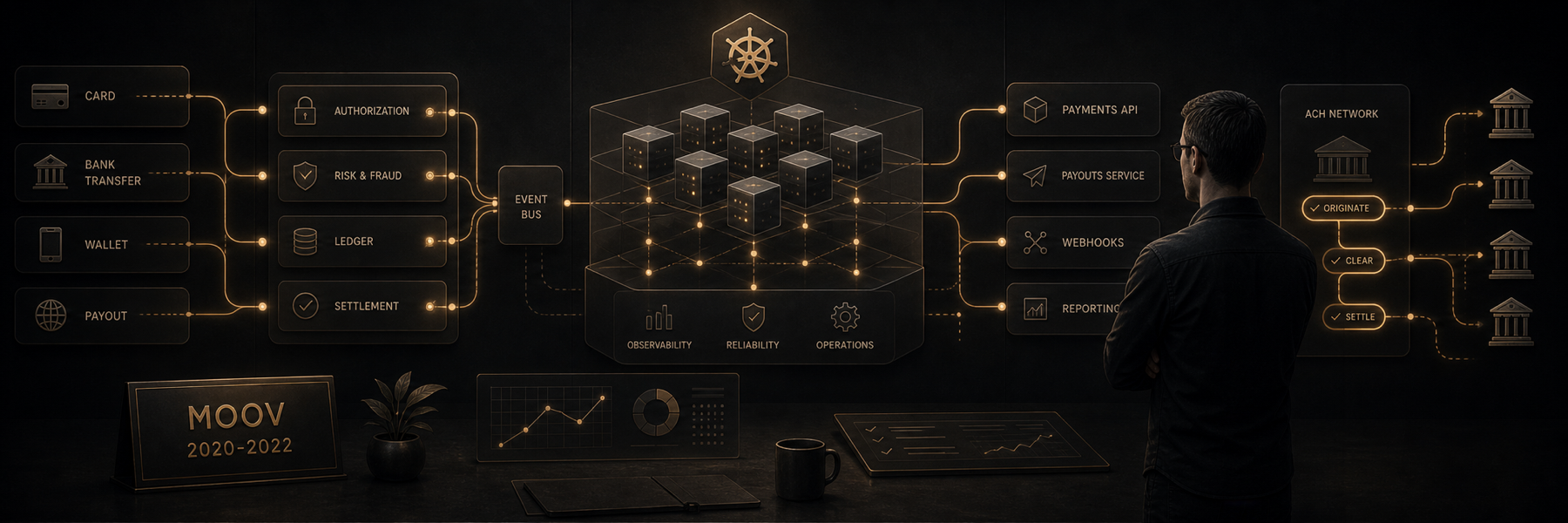
The first Moov run belongs in S tier because it felt like finding my lane. Infrastructure and ACH work gave me the blend I had been circling for years: backend product engineering, distributed systems, operational discipline, Go, Kubernetes, and the kind of payments problems where correctness has teeth.
What this job taught meI found the center of gravity I kept coming back to: payments infrastructure, backend systems, operational correctness, and the kind of engineering where details have financial consequences.
ANerd UnitedLead Software Engineer2022–2024Back to tier list The work was not just building features; it was owning the shape of the product and the stack.
A · Technical OwnershipOwning the Direction

Nerd United was a leadership-heavy season. Architecture, quality, final technical calls, and team direction all lived close together, which made it less about proving I could build and more about helping the right thing get built by more than one person.
What this job taught meLeadership changed from making decisions to making decisions travel well. The work was getting architecture, team direction, and execution to reinforce each other.
BMoov FinancialSr. Software Engineer (Core, Bank Rails, Platform Cards)2024–2026Back to tier list Coming back made the work stronger, but the first pass had already changed the trajectory.
B · Returning With Better ToolsThe Second Pass

The second Moov stint is the ranking that probably needs the most explanation. It was recent, senior, and technically strong. I worked across bank rails, Core, and Platform Cards. I led API versioning across more than sixty services. I helped build an iOS SDK for Tap to Pay. I worked on ACH, RTP, FedNow, and bank account services.
So why B? Because the ranking is about how much the job changed me, not how impressive the work sounds afterward. This round used a lot of instincts the first Moov stint had already built. It refined them, stressed them, and gave them more surface area, but it did not redraw the map in the same way. Sometimes seniority is evidence of previous transformation, not the source of a new one.
The work was stronger than before; the lesson was quieter.
What this job taught meSenior work can be more about refinement than reinvention. This chapter strengthened instincts I already had: API evolution, platform stewardship, and patience with long-lived systems.
The strange thing about ranking a career this way is that the list refuses to match the resume. The founder title is not automatically S tier. The shortest job is not automatically meaningless. The more recent senior role is not automatically the most formative. What matters is whether a job left behind a new instinct. Some taught me how to build. Some taught me how systems fail. Some taught me what kind of work I should keep choosing. That is the tier list I actually care about.
April 21, 2026
Three things that stuck from Intermediate Accounting, twenty years later.
One of the most useful classes I ever took for software engineering wasn't a CS class. It was Intermediate Accounting.
I decided to major in accounting at the University of Utah with an emphasis on Management Information Systems. Twenty years in, working on payment systems for a living, I've realized how important that decision was. Here are three specific things that actually stuck.
I. AccrualTime and cash are different things

In accounting school, the thing that bent my brain the most wasn't debits and credits — it was the accrual principle. Revenue gets recognized when it's earned, not when the cash shows up. An expense belongs to the period it was incurred, not the period you wrote the check. Time and cash are two separate axes, and mixing them up is how books get cooked.
Years later, at Nerd United, we were processing large purchases of blockchain nodes over a parallel L1 Ethereum network. Transactions finalized on-chain quickly most of the time — but purchases made near the end of a month had a way of slipping across the period boundary. A sale initiated on the 31st could finalize on the 1st, and our monthly reports would quietly drop it into the wrong bucket.
It was the matching principle wearing a blockchain costume. The fix wasn't technical — it was recognizing which timestamp defined the period, then designing around that, not around whenever the chain happened to confirm.
It was the matching principle wearing a blockchain costume.
II. Audit TrailsHistory has to be legible

Accountants have a rule: you don't erase anything. When something's wrong, you don't change the entry — you post a correcting entry right after it, with its own date and reason. The history is the point. But there's a second, quieter rule: the history has to be legible. A locked filing cabinet is not an audit trail.
At Moov, we had genuinely great observability for most of the platform — OpenTelemetry, rich traces, persisted events, most of the important things queryable and reproducible. But a handful of edge-case sandbox ACH flows were black boxes. Events were stored but not queryable; logs didn't carry enough context to reconstruct what had happened. I spent hours digging, backfilling logs, and adding traces until the gap closed.
Keeping history isn't the hard part. Keeping history that can be read — by you, by the next engineer, by future-you at 2 AM during an incident — is. An audit trail nobody can follow is a liability with extra storage cost.
An audit trail nobody can follow is a liability with extra storage cost.
III. ReconciliationProve it twice
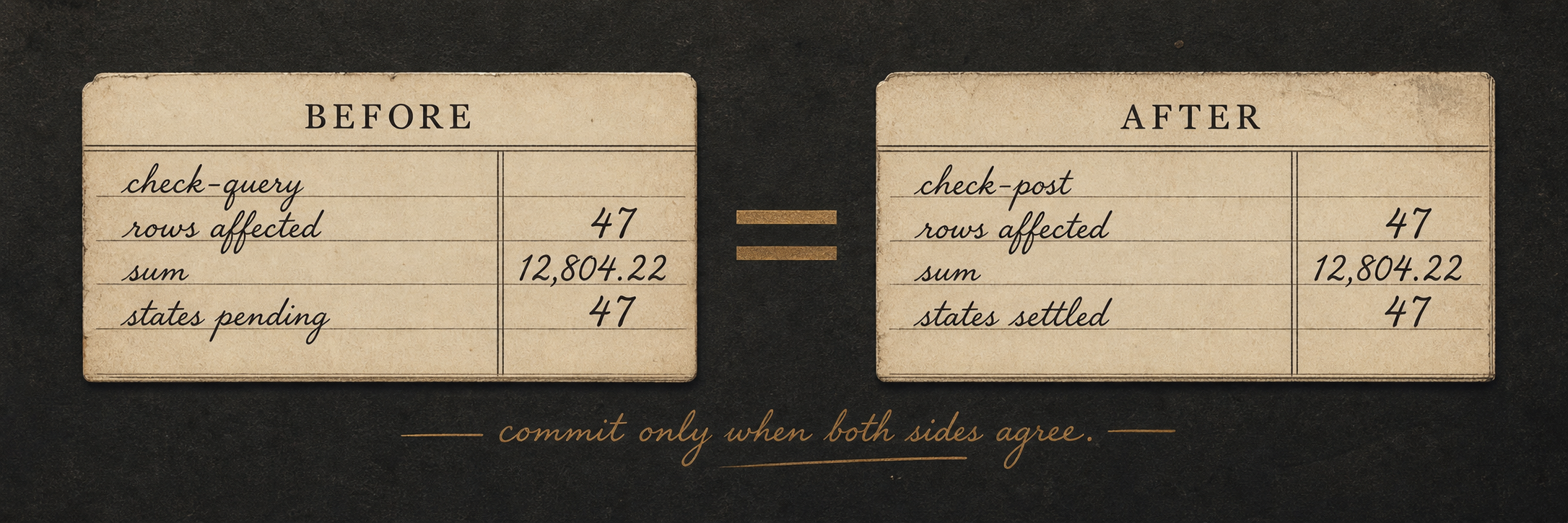
One of the deepest habits accounting gave me is reconciliation — the practice of proving a number by reaching it two different ways. If the two answers don't match, something is wrong, and you don't move on until you know why.
At Moov, when an incident caused data corruption — transactions in the wrong state, amounts or timestamps that needed repair — the fix itself was never the whole job. Every remediation query was bracketed: check queries first, to establish the current state and the expected scope of the change. Then the update, inside a transaction. Then check queries again, before commit, to confirm the change matched the plan — no more, no fewer. If the numbers didn't agree, I rolled back and started over.
That's just reconciliation, applied to a database instead of a ledger. Same posture: measure, change, re-measure, and refuse to move on until both sides agree.
That's just reconciliation, applied to a database instead of a ledger.
Those are three things that actually stuck: a sense for where time lives in a system, a refusal to let history disappear, and a habit of proving a number before I trust it. None of them came from a CS textbook. All three have earned their keep more times than I can count. The degree turns out to have been an engineering degree, too. I just didn't know it at the time.
February 4, 2026
I always enjoy reading these, so here's mine for 2026: practical, ergonomic, and tuned for staying in flow.
Philosophy
My setup goal is simple: reduce friction and protect focus.
If a tool helps me move faster with less context switching, it stays. If it adds complexity without payoff, it goes.Hardware
I spend a lot of time at my desk, so comfort and ergonomics come first.
- MacBook Pro M2
- Two external monitors (27" + 24"), splayed in a curved layout
- Split mechanical keyboard for better wrist/shoulder comfort
- Magic Mouse
- Large desk mat under keyboard and mouse
- Blue microphone
- Bluetooth sound bar behind the monitors
- Autonomous adjustable standing/sitting desk
Nothing here is "hype gear"—it's all about sustainability for long coding sessions.
Editor
I use Neovim, and one of my big recent changes was moving from VimScript to Lua.
I'm now fully on "true Neovim," and it's been worth the migration.I try to keep my editor setup powerful but intentional: fast startup, clean defaults, and tools that genuinely earn their spot.
Terminal + Shell
My terminal setup is:
- Ghostty
- zsh
- A large collection of aliases and shell functions
I've built up hundreds of shortcuts over time to run common commands quickly.
For me, this is one of the biggest productivity multipliers in my workflow.Git Workflow
I keep Git pretty lightweight:
- Small, focused branches
- Clear commits
- Minimal drama in PRs
- Prefer workflows that make future maintenance easier
The goal is to make collaboration smoother and reduce "what happened here?" moments later.
AI in My Workflow
I use AI as a coding partner, not autopilot.
Main tools in rotation:
- Claude Code (primary)
- GitHub Copilot
- Codex
- Gemini
I use them for exploration, drafting, refactoring, and unblocking—but still validate logic and edge cases myself.
Productivity Defaults
A few habits that consistently help:
- Keep repetitive work scripted
- Bias toward reusable commands and shortcuts
- Iterate on tooling in small steps
- Optimize for energy and consistency, not novelty
What I'm Changing Next
Current upgrades in progress:
- Some plugins from my old Vim setup didn't migrate cleanly yet
- Building more snippets for frequently used code blocks
That's where my setup stands right now.
It's always evolving, but this is the stack that helps me ship reliably in 2026.June 9, 2022
Vim workflowSix small navigation habits that make Vim and NeoVim feel less like a text editor and more like an instrument.
I've been a heavy Vim and NeoVim user for more than 10 years. For a long time I still kept one foot in the JetBrains world because GoLand, PyCharm, IntelliJ, and RubyMine had debugging features I relied on. After moving fully into NeoVim, especially with vim-go and delve, I started feeling much faster.
These are the six navigation tricks that have helped me the most over the years.
1. NeoSnippet
The NeoSnippet plugin lets you define small templates for common code, or use predefined snippets for many languages. The default Go snippets include a test function template like this:
go.snipvim 1# test function 2snippet test 3abbr func TestXYZ(t *testing.T) { ... } 4 func Test${1:Function}(t *testing.T) { 5 ${0} 6 }Type
testto activate the snippet, then use Ctrl+k to jump through each placeholder.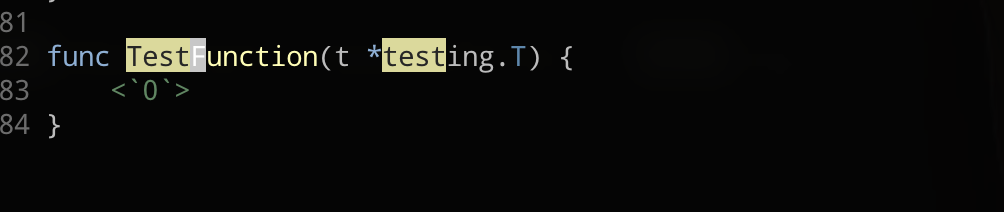
The snippet expands into a full Go test function and places the cursor on the first placeholder. 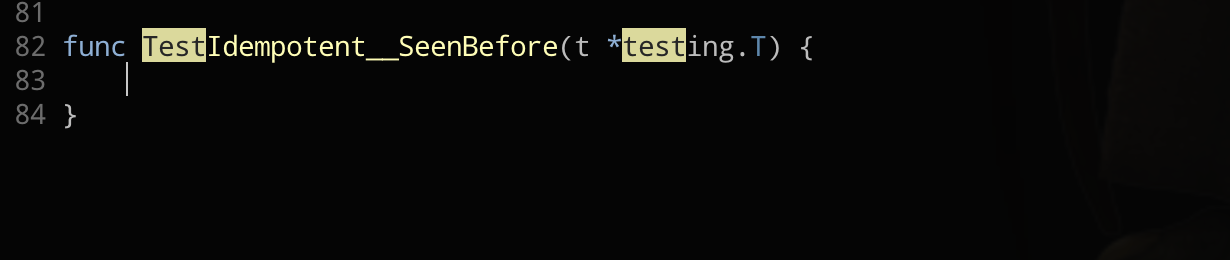
After naming the test, Ctrl+k jumps to the body placeholder. 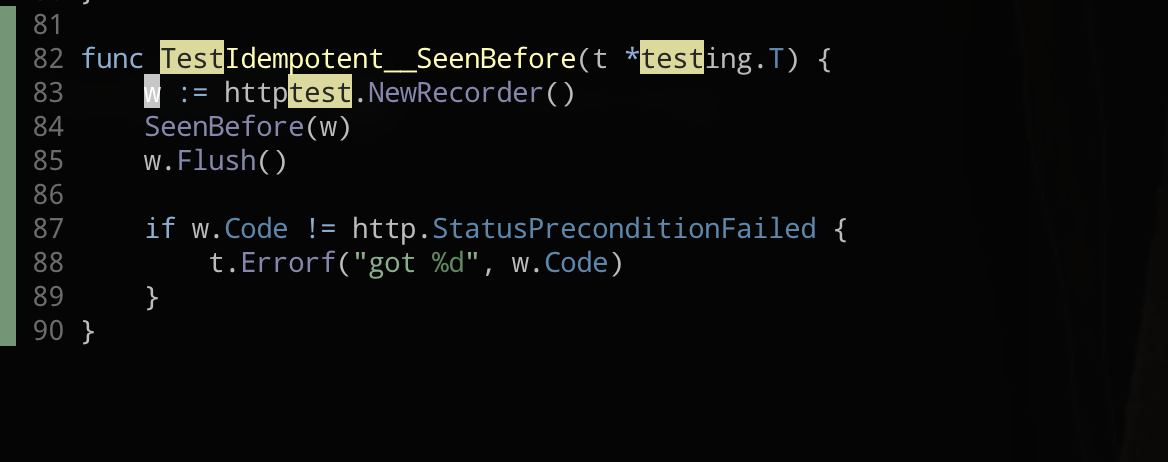
The final version saves a handful of repetitive keystrokes every time a new test starts. 2. EasyMotion
The EasyMotion plugin changed how I move through buffers. Built-in commands like
gg, Shift+g, and10jare useful, but jumping to a precise spot in the middle of a visible line can still cost several keystrokes.With EasyMotion, I type
<leader>w, the buffer fills with highlighted characters, and I type the two-character target closest to where I want to land.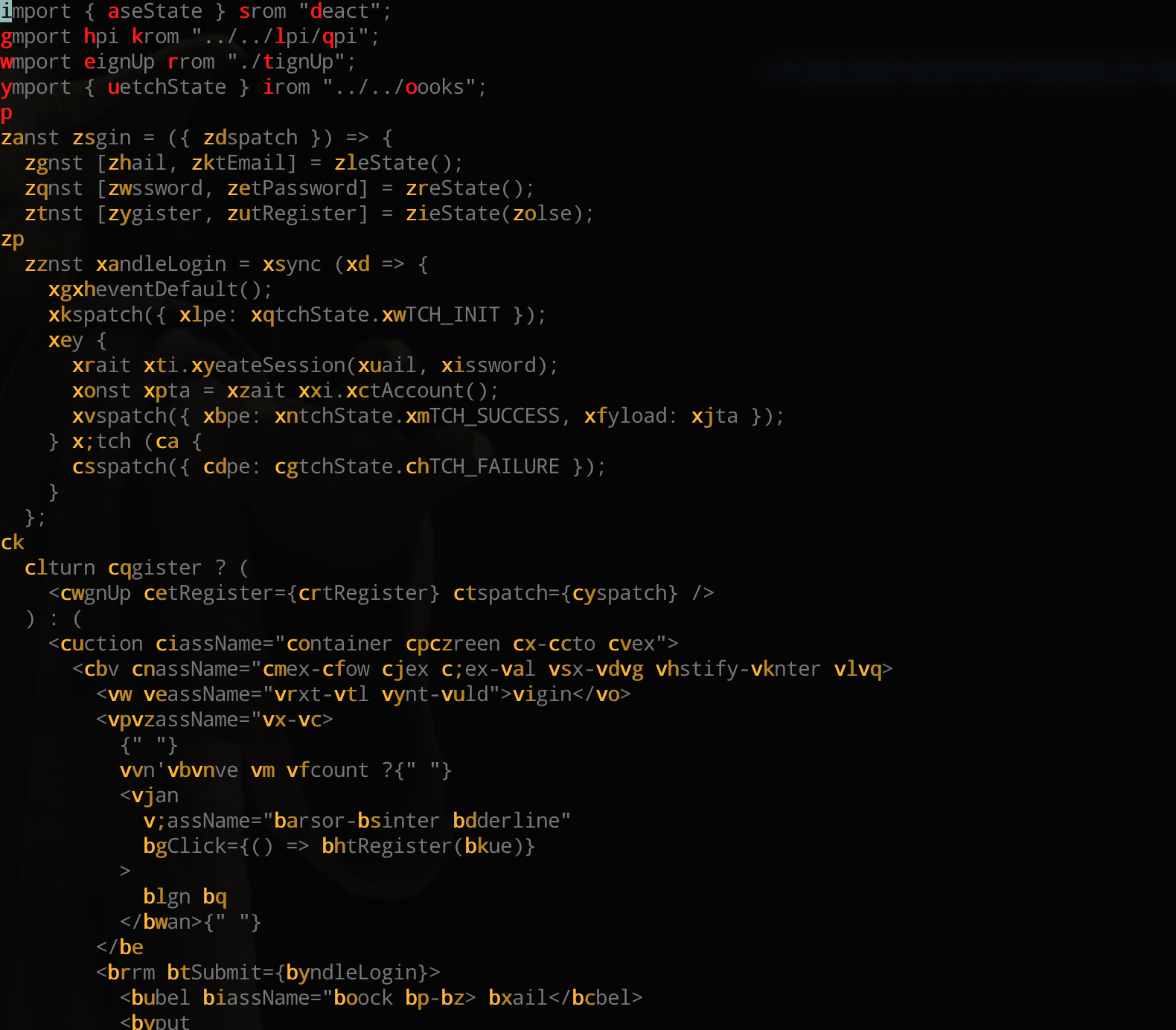
EasyMotion marks the visible buffer with target labels. 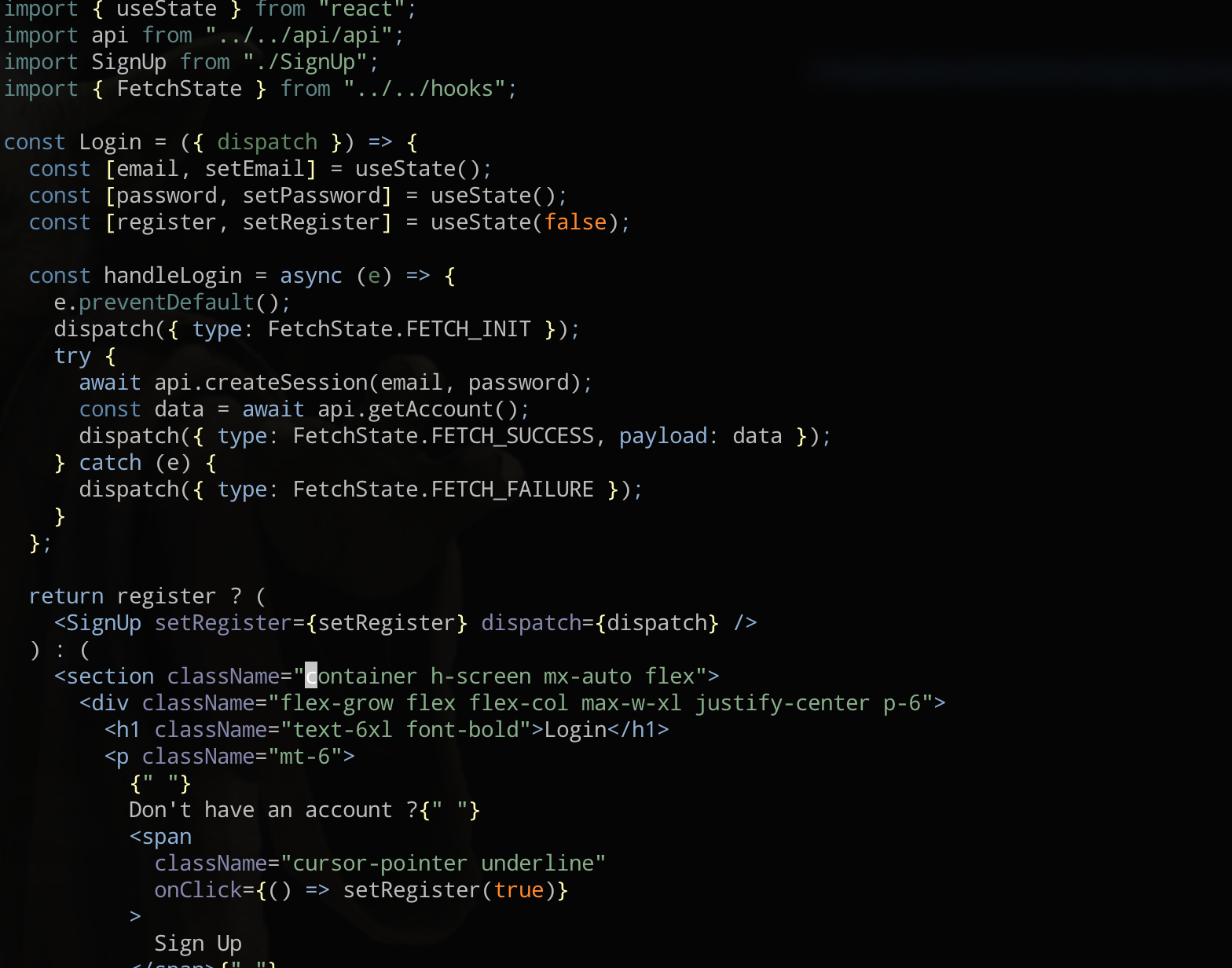
Typing the target label jumps the cursor directly to the desired word. 3. FZF.vim
FZF is a command-line fuzzy finder, and FZF.vim brings that search flow into Vim. I use this function in my init.vim so
<leader>gsearches from the Git project root when possible.init.vimvim 1nnoremap <leader>g :call FZFProjectRoot()<CR> 2 3" search from the git root if we're in a git repo 4function! FZFProjectRoot() 5 let project_root = system('git rev-parse --show-toplevel 2> /dev/null')[:-2] 6 if strlen(project_root) > 0 7 call fzf#run(fzf#wrap('FZFProjectRoot', {'dir': project_root})) 8 else 9 call fzf#run(fzf#wrap('FZFProjectRoot')) 10 endif 11endfunction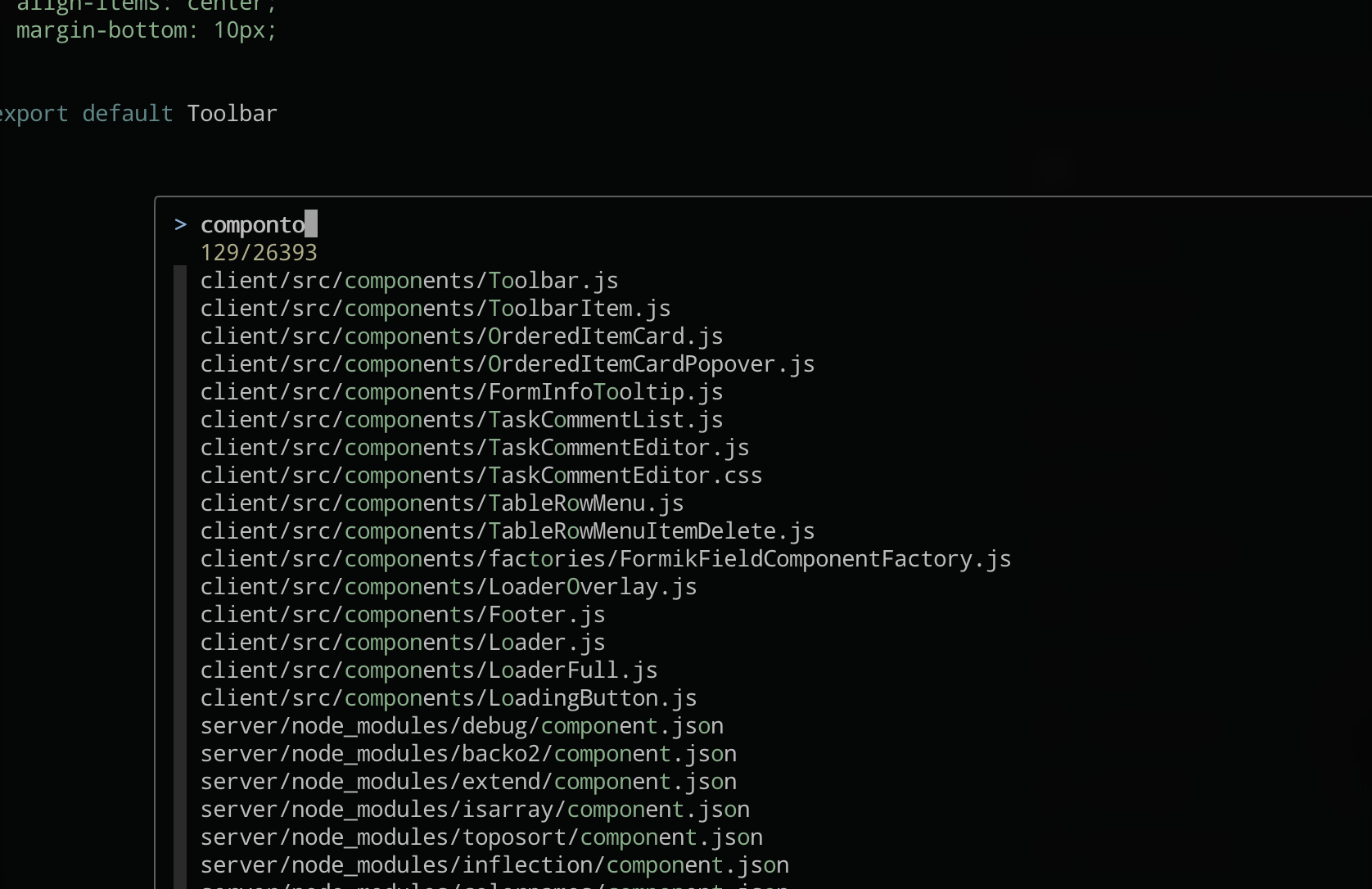
Project-root fuzzy search is one of the fastest ways to get from thought to file. 4. NERDTree
NERDTree is a Vim file explorer. It is not always faster than the standard explorer, but it gives me a clear visual map of a project, and it works nicely with search and motion inside the tree buffer.
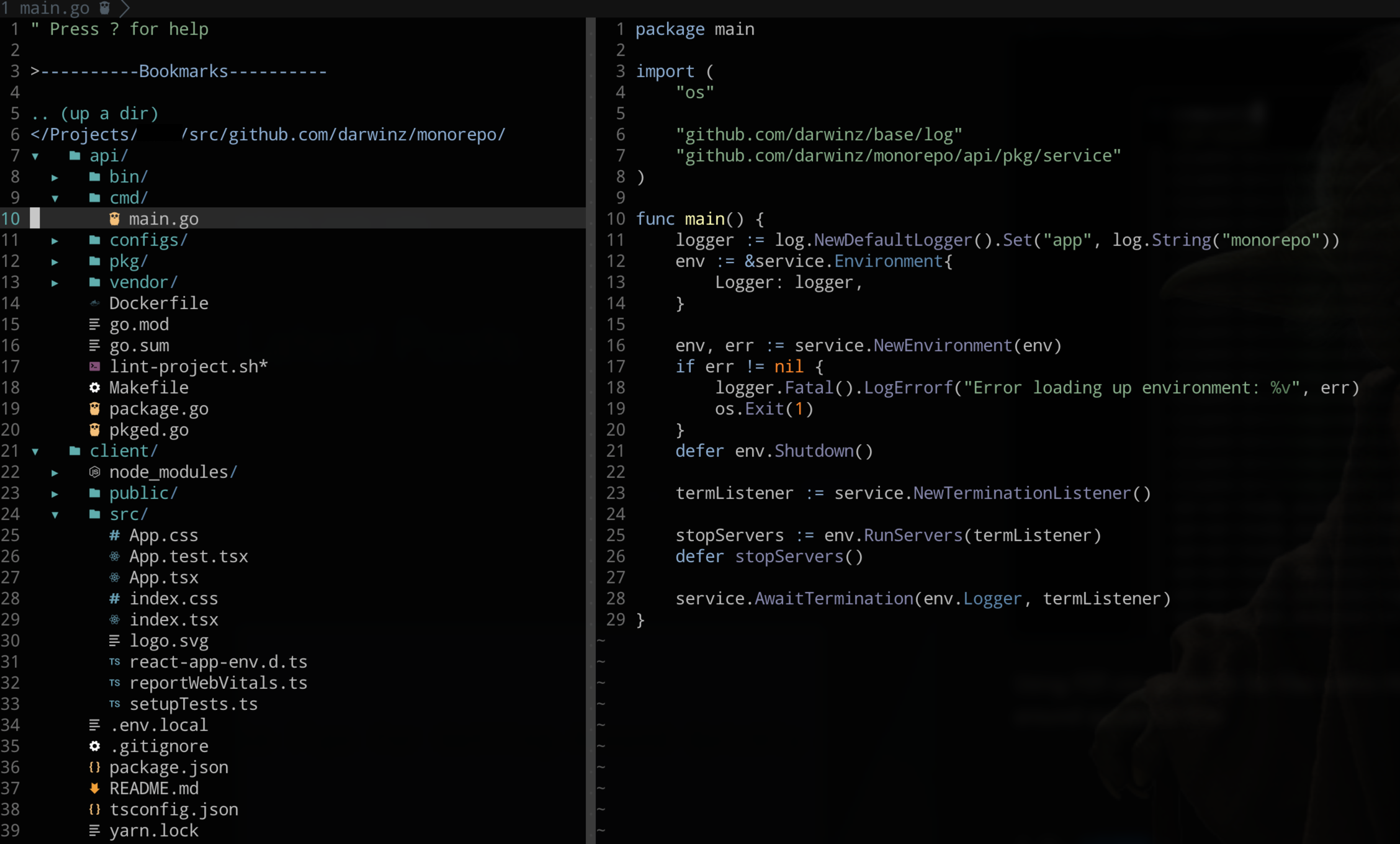
NERDTree is most useful when I need a quick visual sense of the project shape. I keep NERDTree closed by default, then use mappings for toggling it or opening it at the current file.
init.vimvim 1nmap <leader>n :NERDTreeToggle<CR> 2nmap <C-l>l :NERDTreeToggle<CR> 3nmap <leader>f :NERDTreeFind<CR>5. Tagbar
Tagbar shows the structure of the current file: classes, functions, constants, variables, and other configured tags. The real value is jumping between those tags without scanning manually.
By default, Tagbar uses ctags, and some language ecosystems can provide richer tag support. Vim-go, for example, integrates Tagbar through gotags.
6. Search the current buffer
The last habit is plain Vim search. Type
/toolbar, press Enter, and Vim jumps to the first match in the current buffer. Then usento move forward andNto move backward through matches.These habits are small on their own, but together they change the feel of the editor. Once they become muscle memory, moving through a project starts to feel nearly frictionless.
September 2, 2021
Python + shellA small pattern for calling Python helpers from a shell migration script without turning the shell script into a data file.
This is a simple demonstration of how to use Python from within a shell script. Both Python files below are imported and their functions are accessed from the shell script at the bottom.
Lookup maps
Keep the Python side boring: plain dictionaries, small lookup functions, and empty-string fallbacks when a value is not configured.
api_key_maps.pypython 1new_api_keys_map = { 2 "consumer1": "abcd-efgh-ijklmnop", 3 "consumer2": "bcda-fghe-jklmnopi", 4 "consumer3": "cdab-ghef-klmnopij", 5} 6 7def get_new_key_by_name(name): 8 return new_api_keys_map.get(name, "")kafka_secret_maps.pypython 1kafka_consumer_secret_replace_map = { 2 "secret1": {2: "secret-value1"}, 3 "secret2": {2: "secret-value2"}, 4 "secret3": {2: "secret-value3"}, 5} 6 7def get_kafka_consumer_secret_replacement(name, num): 8 return kafka_consumer_secret_replace_map.get(name, {}).get(num, "")Shell bridge
The shell script can ask Python for the values it needs and keep the rest of the migration flow in zsh.
migrate_confluent.shbash 1#!/bin/zsh 2 3 NEW_KEY=$( 4 /usr/bin/env python3 - <<EOF 5from api_key_maps import get_new_key_by_name 6key = get_new_key_by_name("${GROUP}") 7print(key) 8EOF 9) 10 11 REPLACEMENT=$( 12 /usr/bin/env python3 - <<EOF 13from kafka_secret_maps import get_kafka_consumer_secret_replacement 14replacement = get_kafka_consumer_secret_replacement("${GROUP}", ${NUM}) 15print(replacement) 16EOF 17)February 5, 2021
I often take lessons from sports for personal development in business and in my personal life. One thing I recently recognized is that Competitiveness is a drive that must be team-oriented.
For example, if a superstar on a basketball team is ultra competitive, but less interested in team success and more interested in personal accolades and scoring the most points, that team is rarely successful. On the other hand, if that same superstar learns to become more interested in the success of the team, then that team has a much greater chance of having success.
The same goes for teams in business. I've been on teams where certain individuals are more interested in their own personal career growth and their own accolades and show zero interest in the success of the team as a whole. Those teams were almost always much less successful than teams whose individual members all cared about the success of the team as a whole.
I've tried to take that lesson with me to every team I am part of, and try to quickly correct myself whenever I find myself seeking personal attention or accolades ahead of my team. I also try to quickly take ownership for team failures and am quick to recognize my team for team or individual successes.
November 9, 2020
AlgorithmsA compact walkthrough of building a binary search tree and reading it back in sorted order.
Binary trees are encountered often in programming. It's a very simple and efficient data structure that can be used to solve many problems in software systems.
For example, binary trees are used for decision trees, sorting, database indexing, data compression, blockchains, search, and many other applications in software.
An inorder traversal over a binary search tree visits the left branch, then the current node, then the right branch. With a valid BST, that gives us the values in sorted order.
Define the node
First, create a Node class. Each node can hold up to two children, plus the value stored in the node.
node.pypython 1class Node(object): 2 left, right = None, None 3 4 def __init__(self, data=None): 5 self.data = dataInsert values recursively
The insertion function compares each value with the current node and recurs into the left or right subtree.
insert.pypython 1# Binary search tree insertion 2def insert(root, key): 3 4 # if the root is None, create a new node and return it 5 if root is None: 6 return Node(key) 7 8 # if the given key is less than the value of the root node, 9 # recur over the left subtree 10 if key < root.data: 11 root.left = insert(root.left, key) 12 13 # otherwise, recur for the right subtree 14 else: 15 # key >= root.data 16 root.right = insert(root.right, key) 17 18 return rootBuild and traverse the tree
Construct the tree from a list of keys, then traverse it inorder to print the sorted sequence.
construct_bst.pypython 1def constructBST(keys): 2 root = None 3 for key in keys: 4 root = insert(root, key) 5 6 return rootinorder.pypython 1def inorder(root): 2 if root: 3 inorder(root.left) 4 print(root.data, end=' '), 5 inorder(root.right)Run the examplepython 1keys = [1, 2, 5, 6, 3, 4] 2 3root = constructBST(keys) 4inorder(root)Resulting tree
The binary search tree from the
constructBSTfunction looks like this:Binary Search Tree 1 \ 2 \ 5 / \ 3 6 \ 4The output after running the inorder function is the sorted version of the raw input list:
1 2 3 4 5 6
ACH Gateway
moov-io/achgateway
golang, fintech
ACH Gateway
https://github.com/moov-io/achgatewayACH Gateway is an extensible, highly-available, distributed, and fault-tolerant ACH uploader and downloader. ACH Gateway creates events for outside services and transforms files prior to upload to fit real-world requirements of production systems.
IRS
moov-io/irs
golang, fintech
IRS
https://github.com/moov-io/irsIRS implements a reader, writer, and HTTP server for IRS electronic Filing Information Returns Electronically (FIRE). Our tools and library operate at higher levels (JSON) which makes it easier for developers to leverage over the raw bytes (ASCII).
ACH
moov-io/ach
golang, fintech
ACH
https://github.com/moov-io/achACH implements a reader, writer, and validator for Automated Clearing House (ACH) files. ACH is the primary method of electronic money movement throughout the United States. The HTTP server is available as a Docker image and the Go package github.com/moov-io/ach is available.
Moov Infra
moov-io/infra
infrastructure, terraform
Moov Infra
https://github.com/moov-io/infraThis repository holds the configurion for moov.io's infrastructure. If you believe you have identified a security vulnerability please responsibly report the issue as via email to security@moov.io. Please do not post it to a public issue tracker.
Algorithms in PHP
TheAlgorithms/PHP
algorithms, data structures, php
Algorithms in PHP
https://github.com/TheAlgorithms/PHPTheAlgorithms is an Open Source resource for learning data structures and algorithms in various programming languages. The group maintains 34 repositories, and I am part of the maintainers group for TheAlgorithms/PHP repository.
Thnkfl App
darwinz/thnkfl
react, javascript, next.js, appwrite
Thnkfl App
https://github.com/darwinz/thnkflA simplistic and minimal daily gratitude journal to add positivity to your day built with React, Next.js, and powered by AppWrite on the backend
Reveal.js
hakimel/reveal.js
javascript, slideshow, slides, presentation
Reveal.js
https://github.com/hakimel/reveal.jsreveal.js is an open source HTML presentation framework. It enables anyone with a web browser to create beautiful presentations for free. Check out the live demo at revealjs.com.
The framework comes with a powerful feature set including nested slides, Markdown support, Auto-Animate, PDF export, speaker notes, LaTeX typesetting, syntax highlighted code, and an extensive API.
Kudos
darwinz/kudos
golang, vue.js, okta, mongo, docker
Kudos
https://github.com/darwinz/kudosGo API and Vue.js SPA frontend. GitHub repo keyword search with a feature allowing users to upvote (give kudos) to found repos.
Blackbox
StackExchange/blackbox
cybersecurity, secrets, pgp
Blackbox
https://github.com/StackExchange/blackboxSafely store secrets in a VCS repo using Gnu pgp encryption. Blackbox provides a wrapper around Gnu pgp encryption.
Expo Examples
expo/examples
expo, javascript, typescript
Expo Examples
https://github.com/expo/examplesEasy example for using features, libraries, and other integrations with the Expo SDK.
Slack Newman Reporter
jackcoded/newman-reporter-slackmsg
newman, postman, node.js, slack
Slack Newman Reporter
https://github.com/jackcoded/newman-reporter-slackmsgCustom Newman (Postman API monitoring) reporter to send reports to Slack.
Slackin Community Slack Signup Service
emedvedev/slackin-extended
javascript, slack
Slackin Community Slack Signup Service
https://github.com/emedvedev/slackin-extendedA landing page you can point users to fill in their emails and receive an invite to your community Slack.
GitHub Trending Bitbar (Xbar) Plugin
mfks17/bitbar-plugin-github-trending
bitbar, xbar
GitHub Trending Bitbar (Xbar) Plugin
https://github.com/mfks17/bitbar-plugin-github-trendingThis Bitbar (Xbar) plug-in displays the daily trending of your favorite language from Github.
Object-Oriented File System
darwinz/oo-file-system
python, oop
Object-Oriented File System
https://github.com/darwinz/oo-file-systemAn object-oriented file-system developed in Python.
My Budgeting App
darwinz/elixir-react-budgeting
elixir, react, financial
My Budgeting App
https://github.com/darwinz/elixir-react-budgetingA simple income / expense tracking app, built with Elixir / Phoenix and React.
Pic Picker Mobile App UI
H3dgy/Pic-Picker-Front-End
mobile, expo, react native
Pic Picker Mobile App UI
https://github.com/H3dgy/Pic-Picker-Front-EndPic-Picker is a React Native / Expo mobile dating app that I used in a demo for some middle-school aged kids as a church activity. They wanted to learn how to make a dating app.
Pic Picker Mobile App Server
H3dgy/Pic-Picker-Server
mobile, expo, node.js, express
Pic Picker Mobile App Server
https://github.com/H3dgy/Pic-Picker-ServerPic-Picker is a React Native mobile dating app that I used in a demo for some middle-school aged kids as a church activity. They wanted to learn how to make a dating app.
Professional
Professional Summary
I'm a Lead Software Engineer with over 15 years of experience. I'm from West Jordan, Utah
| Name | Brandon Johnson |
|---|---|
| Current Role | Senior Software Engineer |
| Organization | Moov Financial |
| Location | Fully Remote |
| Website | https://moov.io |
| Personal Public GitHub | https://github.com/darwinz |
Moov Financial
( 2024 - 2026 )Sr. Software Engineer
Brandon contributed across multiple teams — bank rails, Core, and Platform Cards. On the Core team, he led an initiative to version APIs across 60+ microservices, enabling safe API evolution at scale. On the Platform Cards team, he led development of an iOS SDK for Tap to Pay. He also developed and evolved backend integrations for ACH, RTP, FedNow, and bank account services as part of Moov's payments platform.
Nerd United
( 2022 - 2024 )Lead Software Engineer
As lead software engineer, Brandon was the tech lead for software development projects. Brandon led a team of software engineers, and directed the development of the company's software products. He was responsible for the overall architecture of the software, and for the quality of the code. He also drove decisions related to technology initiatives and had the final say for technical decisions related to sofware projects.
Moov Financial
( 2020 - 2022 )Sr. Software Engineer, Team Lead
Brandon was a lead for an infrastructure team and an ACH team. He was lucky to have a good blend of software feature development with Golang plus infrastructure and devops work.
Lucerna Health
( 2020 - 2020 )Lead Software Engineer
Brandon developed ETL data pipelines and REST APIs that support internal and client-facing applications. He also built some client-side (frontend) features.
REDfolio
( 2019 - 2020 )Co-Founder, Director of Engineering
REDfolio is a SAAS company providing a process and portfolio management solution for real estate developers, helping real estate development companies through the pre-development, construction, and operation stages.
Banjo
( 2018 - 2020 )Lead Software Engineer
Brandon developed real-time data pipelines enabling ML analysis and in-product features and developed RESTful and GraphQL APIs at scale for customer-facing products (AWS spend per month was $450,000 and reached over $1M per month). Brandon became a team lead in 2020 and led a team of 6 engineers.
Cricut
( 2015 - 2018 )Sr. Software Engineer
Brandon worked on several software projects spanning a variety of tech stacks, including Magento (PHP), Python, Node, Angular, Drupal, and WordPress. Projects included: REST APIs that support Cricut’s award-winning DesignSpace software and mobile apps, APIs that support interaction with Cricut embedded devices, a Magento shopping cart.
Apptys
( 2009 - 2015 )Lead Software and DevOps Engineer
Full-service software and web development agency, co-founded by Brandon, specialized in custom e-commerce and application development with PHP, Magento, Wordpress, Big Commerce, WooCommerce, Ruby on Rails, Linux, iOS, and Android. Brandon was involved in every aspect of the business, from sales and finance to client interaction and hiring to project planning and management to software architecture and development.
Guidance Solutions
( 2013 - 2014 )Technical Lead - Magento
Responsible for developing overall technical strategy and overseeing development for large-scale, high traffic external client projects. Technical lead was a staff-level or lead-level IC role with additional responsibilities related to client interaction and technical leadership over project implementations. Tech leads also work closely with project managers and lead scrum meetings.
Clearlink
( 2010 - 2013 )Sr. Full-Stack Developer
Brandon worked with a team to develop and maintain a robust sales order management system that is used by Clearlink's 800+ sales associates and is integrated with several other software systems, such as the company's inbound sales phone system and its brand partner APIs. Thousands of orders across 15+ nationwide brands and credit card payment transactions are processed through the system and sent to brand partners each day.
Green PolkaDot Box
( 2009 - 2010 )Magento Developer
Brandon worked with a small team in the development of a heavily customized implementation of Magento, adding key features and customization to the Customer, Catalog, Sales, and other modules. He also helped with a migration from Magento Community to Magento Enterprise.
Ross Equipment Company
( 2006 - 2009 )Systems and Network Admin
Brandon was responsible for all network systems, data, security, and computer systems across two states - Utah and Nevada. He also often found ways to make improvements to various systems and processes, which provided opportunities to develop solutions by writing code and building software.
University of Utah
( 2001 - 2006 )Bachelor of Science, Accounting
Activities and societies: Sigma Gamma Chi, President of Encore Show Choir
University of Utah
( 2005 - 2006 )Management Information Systems
Double-majored during my final year-and-a-half. Some courses included Database Management Systems (with advanced SQL), Web Programming with Java.
KCNA - Kubernetes and Cloud Native Associate
( Aug 2023 - Aug 2026 )The Linux Foundation
Credential ID LF-wp73kwelu5
https://www.credly.com/badges/ea06137c-8026-417f-82d1-6a939fe87a5e/public_urlGo (basic) certificate
( Aug 2023 - No expiration )HackerRank
Credential ID 3adb8720bcab
https://www.hackerrank.com/certificates/3adb8720bcabAWS Certified Developer - Associate (DVA)
( June 2017 - December 2020 )Amazon Web Services (AWS)
Credential ID 166147
https://www.certmetrics.com/amazon/public/transcript.aspx?transcript=9WD84HQK21VQ1NGGRuby (intermediate) skill assessment
( Sep 2020 - No expiration )HackerRank
Credential ID 2bb14da6fc45
https://www.hackerrank.com/certificates/2bb14da6fc45Zend Certified Engineer (PHP)
( Mar 2013 - No expiration)Zend Technologies, Ltd.
Credential ID ZEND022247
https://www.zend-zce.com/en/yellow-pages/ZEND022247
Contact
Get In Touch
Reach out if you're interested in networking, or if we can benefit each other in some way.
Address
West Jordan, Utah United States